There is no single best saw for every woodworking project. The right choice depends on the type of cuts you make, the materials you use, your available workspace, and your experience level.
For many workshops, a table saw is the most versatile primary machine. But a track saw may be better for sheet goods, a miter saw may be faster for repeated crosscuts, and a bandsaw may be the best tool for curves. Choosing the right woodworking saw means matching the tool to the task.
The Best All-Around Woodworking Saw: Table Saw
For many furniture makers, cabinet builders, and serious DIY users, the table saw is the most useful all-purpose woodworking saw. It excels at long, straight rip cuts and can also handle crosscuts, bevel cuts, dadoes, and many repeatable dimensioning tasks with the right accessories.
A quality table saw usually includes a flat table, adjustable fence, blade-height control, bevel adjustment, and safety features such as a blade guard, riving knife, and anti-kickback pawls.
A table saw is especially useful for:
- Ripping solid timber to width
- Cutting sheet materials into smaller panels
- Repeating accurate cuts
- Making bevel cuts
- Preparing stock for furniture and cabinetry
Its main limitations are space requirements, dust production, and the need for careful safety procedures.
Best Saw for Sheet Goods: Track Saw
A track saw is an excellent choice for cutting plywood, MDF, melamine, and other large sheet materials. The saw runs along an aluminum guide rail, helping users make straight, accurate cuts without moving a heavy panel across a table saw.
For small workshops, mobile installers, and users without space for a large table saw, a track saw can be an efficient alternative. It is also useful for breaking down full-size sheets before making final cuts on another machine.
Best Saw for Crosscuts: Miter Saw
A miter saw is designed for fast and accurate crosscuts. It is especially useful for cutting timber to length, making angled cuts for trim, and repeating the same cut across multiple pieces.
A sliding compound miter saw can cut wider boards and also make bevel cuts. It is popular for framing, trim work, cabinetry, furniture components, and workshop stock preparation.
However, a miter saw is not the best tool for ripping long boards. It complements a table saw or track saw rather than replacing one.
Best Saw for Curves: Bandsaw
A bandsaw uses a continuous loop blade that moves through the workpiece. It is one of the best tools for cutting curves, irregular shapes, and thicker stock.
Woodworkers often use bandsaws for:
- Curved furniture parts
- Decorative shapes
- Resawing wide boards into thinner pieces
- Cutting small parts more safely than on a table saw
- Preparing turning blanks
Blade width and tooth configuration have a major effect on performance. Wider blades are better for straight resawing, while narrower blades are better for tighter curves.
Best Saw for Fine Joinery: Hand Saw or Japanese Pull Saw
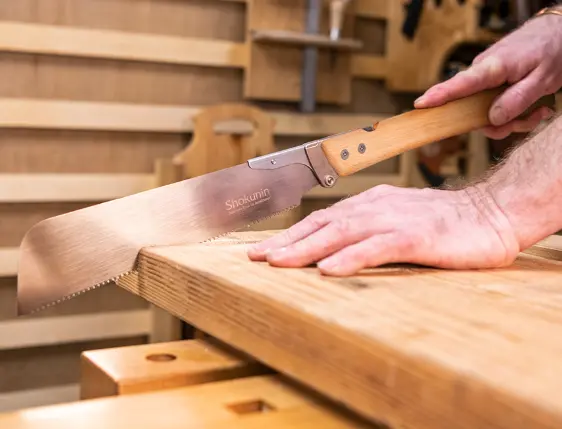
Hand saws remain valuable in modern woodworking. A good backsaw, dovetail saw, or Japanese pull saw offers excellent control for detailed joinery, trimming, and repair work.
Japanese pull saws cut on the pull stroke, which allows for thin blades and fine kerfs. They are widely used for dovetails, tenons, flush trimming, and precise cuts where power tools may be less practical.
For beginners, a quality hand saw is also a low-cost way to learn grain direction, cutting control, and joinery fundamentals.
Best Saw for Small Curves and Cutouts: Jigsaw
A jigsaw is useful for internal cutouts, curved shapes, and tasks where a larger saw cannot reach. It is portable and relatively affordable, making it a common tool for home workshops.
For the cleanest results, use a sharp blade matched to the material, support the workpiece properly, and cut slightly outside the final line before refining the edge with sanding or a router.
How to Choose a Woodworking Saw
Before buying, consider these questions:
- What cuts will you make most often?
- Will you work mainly with solid wood, sheet goods, or both?
- How much workshop space do you have?
- Do you need portability?
- What level of accuracy and repeatability is required?
- Can you manage dust extraction safely?
- What is your budget for the saw, blades, stands, and accessories?
A beginner’s first major saw may be a compact table saw, track saw, or miter saw, depending on the type of projects planned. A growing workshop often adds tools over time rather than relying on one machine for every task.
Why the Blade Matters
Even the best woodworking saw cannot perform well with the wrong blade. Blade tooth count, tooth geometry, kerf width, coating, and material compatibility all affect cut quality.
A ripping blade is designed to cut efficiently along the wood grain. A crosscut blade is designed for cleaner cuts across the grain. Combination blades offer versatility, while fine-tooth blades can improve finish quality in plywood and veneered panels.
Always use a sharp, undamaged blade designed for the saw and material.
Woodworking Saw Safety Essentials
Every saw requires focused operation and appropriate safety habits. Wear eye and hearing protection, keep the work area clear, use dust extraction where possible, and inspect blades before use.
For table saws, use the fence correctly, keep hands clear of the blade path, use push sticks or push blocks when appropriate, and avoid freehand cuts. Never remove safety equipment unless a specific operation requires an approved alternative setup.
Conclusion
The best woodworking saw depends on the job. A table saw is often the most versatile central tool for a dedicated workshop. A track saw is excellent for sheet goods, a miter saw handles crosscuts efficiently, a bandsaw is ideal for curves and resawing, and hand saws remain essential for fine joinery.
The smartest approach is to choose a woodworking saw based on your projects, space, skill level, and safety needs. With the right blade and careful setup, even a modest workshop can produce accurate, professional-looking results.
Post time: 07-22-2026