Antique saws reveal the history of woodworking, carpentry, forestry, and craftsmanship. Before modern power tools became standard, saws were essential for shaping timber, cutting joinery, building furniture, and preparing firewood. Today, collectors, restorers, woodworkers, and interior designers value old saws for their practical engineering, distinctive handle designs, and connection to traditional hand-tool skills.
A vintage saw may range from a small joinery tool to a large two-person crosscut saw. Understanding the major types helps buyers identify the intended use, age, construction, and collecting potential of each piece.
What Makes a Saw Antique or Vintage?
An antique saw is generally an older hand saw or powered saw with historical, collectible, or restoration value. The terms “antique” and “vintage” are often used broadly, but collectors commonly consider age, manufacturer, condition, rarity, original parts, and historical significance.
Features that may help identify an older saw include:
- Wooden handles with decorative carving or medallions
- Carbon-steel blades with aged patina
- Brass saw nuts or fasteners
- Manufacturer stamps or etching
- Hand-filed tooth patterns
- Traditional closed-handle designs
- Signs of hand-forged or early industrial production
- Original labels, cases, or accessories
Condition matters, but a vintage saw does not need to look brand new to be valuable. Honest wear, original finish, readable markings, and intact handles can all add interest.
1. Hand Saws
The hand saw is one of the most recognizable traditional woodworking tools. It usually has a long steel blade and a wooden handle, allowing the user to make straight cuts in boards and timber.
Traditional hand saws are commonly divided into rip saws and crosscut saws.
Rip Saws
A rip saw is designed to cut along the grain of the wood. Its teeth are shaped to remove material efficiently in the direction of the wood fibers.
Antique rip saws were widely used in carpentry, lumber work, and general woodworking. They often have fewer, larger teeth per inch than fine crosscut saws.
Crosscut Saws
A crosscut saw is designed to cut across the grain. Its teeth are shaped to sever wood fibers cleanly, helping reduce tearing and splintering.
A vintage crosscut hand saw may be identified by its finer tooth pattern and its traditional woodworking handle. It is commonly found in home workshops, carpentry collections, and restoration projects.
2. Panel Saws
Panel saws are smaller versions of full-size hand saws. They are designed for cutting smaller boards, cabinet panels, trim pieces, and general workshop stock.
Because they are easier to control than longer saws, panel saws were popular with furniture makers, apprentices, homeowners, and tradespeople. A vintage saw in this category may feature a compact blade, carved hardwood handle, and fine tooth pattern.
3. Back Saws
A back saw has a reinforced metal or brass spine along the top of the blade. The rigid back helps keep the thin blade straight during precise cutting.
Back saws are especially associated with joinery and fine woodworking.
Common types include:
- Tenon saws
- Dovetail saws
- Miter saws
- Carcass saws
- Sash saws
Tenon Saws
A tenon saw is used for cutting tenons and other joinery components. It typically has a deeper blade than a dovetail saw and provides accurate, straight cuts in hardwood and softwood.
Dovetail Saws
A dovetail saw is smaller and finer than many other back saws. It is designed for detailed joinery, especially dovetail joints used in drawers, boxes, cabinets, and fine furniture.
Collectors often value dovetail saws because they demonstrate the precision-focused side of traditional woodworking.
4. Bow Saws
A bow saw uses a narrow blade held under tension in a curved wooden or metal frame. The frame gives the saw its bow-like shape.
Traditional bow saws were used for cutting curves, branches, firewood, and smaller timber. Their lightweight design made them useful for outdoor work as well as general cutting tasks.
An antique bow saw may have a wooden frame, tension cord, wooden toggle, and replaceable blade.
5. Frame Saws
A frame saw is a larger version of the bow-saw concept. It has a rectangular or H-shaped frame that holds a long blade under tension.
Frame saws were used for resawing, cutting boards, breaking down timber, and preparing lumber in traditional workshops. They are often associated with early furniture making, cabinet work, and hand-tool woodworking.
6. Two-Person Crosscut Saws
Two-person crosscut saws are large saws designed for cutting logs. They have handles at both ends so two operators can work together.
These saws were common in forestry, logging, farm work, and firewood preparation before chainsaws became widespread. They may feature large, aggressively shaped teeth designed for efficient cutting through green or dry timber.
Because of their size and strong visual presence, large two-person saws are popular as wall decorations in workshops, restaurants, cabins, and rustic interiors.
7. One-Person Crosscut Saws
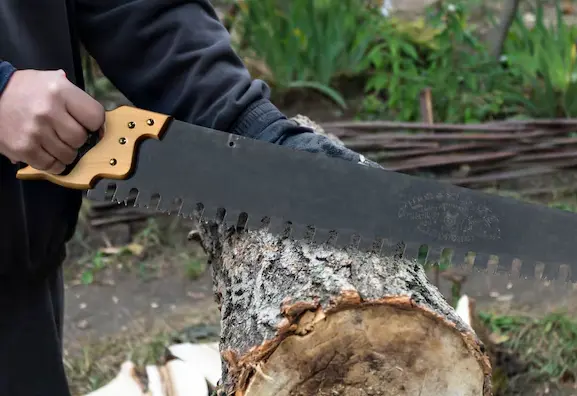
A one-person crosscut saw is also designed for cutting logs, but it is operated by one user. It usually has a long blade with a handle at one end and a pointed or tapered nose at the other.
These saws were practical for farm maintenance, small-scale forestry, and outdoor timber cutting. They remain popular among collectors of rural and traditional woodworking tools.
8. Compass and Keyhole Saws
Compass saws and keyhole saws are designed for curved, internal, or narrow cuts.
A compass saw typically has a long, narrow blade that tapers toward the tip. It can be used to cut curves in boards or openings in wooden panels.
A keyhole saw is smaller and is often used for cutting openings for locks, hardware, pipes, and small interior details.
A vintage saw of this type may have a turned wooden handle and a narrow steel blade with a fine or medium tooth pattern.
9. Veneer Saws
A veneer saw is a specialized fine-tooth tool used for cutting thin wood veneer. It often has a short blade and teeth arranged for controlled cuts across delicate material.
These saws were used in cabinetmaking, marquetry, furniture restoration, and decorative woodwork. Their small size and specialized purpose can make them interesting additions to a hand-tool collection.
10. Pruning and Orchard Saws
Pruning saws are designed for cutting branches, shrubs, and small trees. They commonly have curved blades, coarse teeth, and handles designed for outdoor use.
Antique pruning saws may include folding styles, fixed-blade models, or pole-saw attachments. They are useful examples of how saw design changed to meet agricultural and gardening needs.
How to Evaluate a Vintage Saw
When evaluating a vintage saw, consider the following:
- Is the blade straight and free from major cracks?
- Is the handle complete and structurally sound?
- Are the saw nuts, screws, and medallions original?
- Can the manufacturer's marking still be read?
- Has the blade been excessively ground or reshaped?
- Is the tooth line reasonably intact?
- Does the saw have historical, decorative, or workshop value?
Surface rust does not always mean a saw is beyond restoration. Light rust and patina can often be addressed carefully, while deep pitting, broken teeth, and damaged handles may require more work.
Why Antique Saws Still Matter
Antique saws are more than old tools. They represent practical design, material knowledge, and woodworking traditions developed over generations.
A well-preserved vintage saw can serve several purposes:
- Collection and display
- Workshop decoration
- Historical interpretation
- Traditional woodworking
- Tool restoration
- Educational demonstrations
- Rustic interior design
Whether displayed on a workshop wall or restored for careful use, antique saws continue to hold value for people who appreciate craftsmanship and the history of hand tools.
Final Thoughts
The main types of antique saws include hand saws, rip saws, crosscut saws, panel saws, back saws, bow saws, frame saws, two-person logging saws, pruning saws, and specialized joinery saws.
Each vintage saw was developed for a specific cutting task, from fine dovetail work to heavy log cutting. By understanding blade shape, tooth pattern, handle style, and intended use, collectors and woodworkers can better identify and appreciate these traditional tools.
For saw products and woodworking tool information, visit YFCOO Saw.
Post time: 07-28-2026